You Won’t Believe What I Ate in La Paz
La Paz isn’t just about high-altitude views and colorful markets—it’s a flavor explosion waiting to happen. I went looking for culture and left with my taste buds completely rewired. From sizzling street food to meals that tell ancestral stories, every bite felt like a direct line to Bolivia’s soul. You haven’t truly experienced this city until you’ve tasted it. Let me take you where the locals eat, celebrate, and keep traditions alive through food. In a place where altitude shapes breath and identity, cuisine becomes the quiet pulse of everyday life—a bridge between ancient Andean wisdom and modern resilience. This is not tourism for the eyes alone; it’s nourishment for deeper understanding.
Arrival in La Paz: First Impressions Beyond the Altitude
Touching down at El Alto International Airport, one of the highest in the world, the first sensation is physical: a thinness in the air that makes each breath deliberate. At over 4,000 meters above sea level, the oxygen is sparse, and so is mental clarity upon arrival. The sprawling urban patchwork of La Paz unfolds below like a tapestry woven into the folds of the Andes. As the city descends into its dramatic canyon-like valley, so too does the altitude, offering slight relief as travelers move from El Alto into the heart of downtown.
The visual rhythm of La Paz hits almost as hard as the elevation. Women in bowler hats and layered polleras—full, colorful skirts—move with purpose through bustling sidewalks. Markets spill onto streets, and the air hums with the sound of honking minibuses, street vendors calling out prices, and the distant echo of panpipe music. Amid this sensory overload, it’s easy to feel disoriented, untethered from familiar reference points. But food becomes an anchor. Within hours of landing, I found myself drawn to a small wooden cart emitting a steady plume of steam.
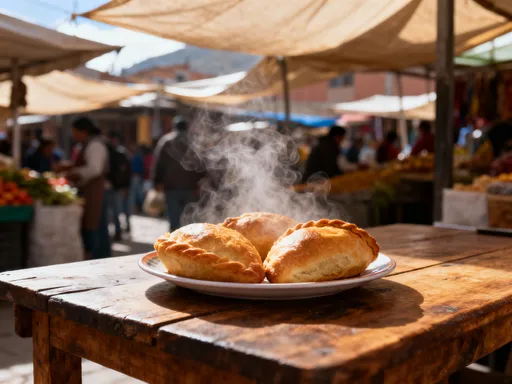
There, beneath a faded tarp flapping in the mountain wind, a vendor handed me a golden-brown empanada de queso, its crust crackling under my fingers. The first bite released molten cheese and a whisper of cumin. It was simple, unpretentious, and deeply comforting. In that moment, I realized that food in La Paz isn’t just sustenance—it’s orientation. It grounds the visitor, offering a tangible way to connect with a culture that might otherwise feel distant or impenetrable. More than museums or monuments, these edible moments provide immediate access to the city’s character.
What makes La Paz unique is how seamlessly food integrates into daily life. Unlike cities where dining is segmented into formal experiences, here, meals unfold in motion—in markets, on corners, in homes where recipes pass from grandmother to granddaughter without ever being written down. To understand La Paz, you must eat your way through it, not as a spectator, but as a participant. The altitude may slow your steps, but it sharpens your attention to detail—the warmth of freshly baked bread, the tang of fermented corn, the smoky depth of slow-grilled meat. These are the textures of belonging.
Street Food as Culture: More Than Just a Quick Bite
If the soul of La Paz lives anywhere, it pulses strongest in its street food. Wander through Plaza Murillo during morning rush hour, and you’ll see office workers pausing mid-stride to unwrap foil-wrapped bundles of salteñas. These steaming, oval-shaped pastries are more than snacks—they’re ritual. Unlike empanadas, which are baked dry, salteñas are steamed, their dough slightly sweetened to balance the savory, gelatin-rich filling that bursts with flavor when bitten into. Inside, you’ll find a mix of beef or chicken, potatoes, olives, raisins, and aji—a spicy pepper paste that adds both heat and complexity.
Historically, salteñas trace their roots to Santa Cruz, but they’ve become a national staple, especially in La Paz, where they serve as the quintessential pre-lunch meal. Eating one properly is an art form: tilt the pastry, bite gently, let the broth trickle into your mouth, then savor the rest. Locals often pair them with a glass of api morado, a warm, thick corn-based drink dyed deep purple by purple maize and spiced with cinnamon and cloves. Together, they form a breakfast duo that fuels the city’s rhythm.
But street food here isn’t just about convenience. It’s a mirror of social life. Along Sagárnaga Street, near the Witches’ Market, vendors grill anticuchos—skewers of marinated beef heart—over open flames. The scent of charred meat and cumin drifts through the air, drawing in curious tourists and hungry locals alike. Though some may hesitate at the idea of offal, anticuchos are a beloved legacy of Afro-Bolivian culinary tradition, particularly in the Yungas region. Their presence in La Paz speaks to the country’s rich cultural blending, where indigenous, African, and Spanish influences converge on a single plate.
Equally emblematic is the choripán—a humble yet satisfying sandwich made with a grilled chorizo sausage tucked into a crusty roll. Often topped with salsa de locoto (a fiery pepper sauce) and raw onions, it’s a go-to for late-night gatherings or post-festival sustenance. What’s striking is how these foods foster connection. At a street cart, strangers stand shoulder to shoulder, sharing space and stories. A vendor remembers your usual order. A neighbor offers a spare napkin. In these micro-moments, food acts as social glue, reinforcing community ties in a city where economic disparities are visible but not always divisive.
For the traveler, embracing street food means embracing authenticity. It requires letting go of sterile dining expectations and welcoming the joy of eating with your hands, standing up, surrounded by noise and movement. There’s dignity in this simplicity. Each bite reflects generations of adaptation—how people have turned limited ingredients into vibrant expressions of identity. To eat like a local in La Paz is to honor that legacy, one steaming pastry at a time.
Mercado Lanza: Where Ingredients Tell a Story
No visit to La Paz would be complete without stepping into Mercado Lanza, one of the city’s oldest and most vibrant public markets. Located in the heart of the downtown district, it opens before sunrise, when the first vendors lay out pyramids of fresh produce, bundles of herbs, and trays of dried fish from Lake Titicaca. The air is thick with the scent of earth, smoke, and simmering broth. Stalls overflow with colors: bright red ají peppers, golden chuño (freeze-dried potatoes), deep purple ulluco tubers, and baskets of pinkish oca, all native to the Andean highlands.
Walking through Mercado Lanza is like reading a living agricultural archive. Quinoa, now celebrated globally as a superfood, has been cultivated in this region for over 5,000 years. Here, it’s sold in bulk, still in its husks, next to varieties like kañiwa and tarwi—lesser-known Andean grains that are equally nutritious. Vendors proudly explain how different types of quinoa grow at specific altitudes, each with its own flavor profile and cooking time. This isn’t just commerce; it’s stewardship of ancestral knowledge.
Meat stalls offer another window into tradition. Alongside cuts of beef and pork, you’ll find llama meat—lean, dark, and slightly gamey—displayed with quiet pride. For centuries, llamas have been essential to Andean life, serving as pack animals, sources of wool, and, when necessary, food. Eating llama is not exotic here; it’s practical and respectful. The animals are raised sustainably, often on family-run highland farms, and nothing goes to waste. Even the bones are used to make rich, restorative soups that locals swear by for combating altitude sickness.
One of the most profound moments in the market came during a conversation with Doña Marta, a Quechua-speaking vendor in her sixties who has sold medicinal herbs and cooking spices at the same stall for nearly four decades. She showed me a bundle of wakataya, a leafy green used in soups, and explained how its harvesting follows the lunar calendar. “The moon tells us when to plant, when to pull,” she said, her hands moving with the certainty of someone who has lived by these rhythms her entire life. Her words revealed a worldview in which food is not separate from nature, but part of a continuous cycle of reciprocity.
This spiritual dimension runs deep in Aymara and Quechua cosmology, where the land—Pachamama, or Mother Earth—is revered as a living entity. Offerings of coca leaves, chicha (fermented corn beer), and small portions of food are made before planting or harvesting. In this context, eating becomes an act of gratitude. The ingredients in Mercado Lanza are not commodities; they are gifts. To cook with them is to participate in a relationship that transcends mere consumption. For the traveler, understanding this connection transforms the way one sees every meal—not just in La Paz, but everywhere.
Cooking Class with a Local Family: Inside a Traditional Kitchen
One of the most transformative experiences of my trip was joining a home-based cooking class in Sopocachi, a residential neighborhood known for its mix of colonial charm and modern convenience. Hosted by Señora Rosa and her daughter Claudia, the afternoon unfolded in their modest kitchen, where the walls were lined with clay pots and shelves held jars of dried peppers, herbs, and homemade preserves. There was no fancy equipment—just a gas stove, wooden spoons, and generations of instinct guiding every motion.
We began with sopa de maní, a creamy peanut soup that belies its humble ingredients. Roasted peanuts are ground into a paste, then simmered with onions, garlic, potatoes, and chuño, creating a dish that is both hearty and subtly sweet. As we stirred the pot, Claudia explained how this soup is often served during cold winter months or after long journeys. “It warms the blood,” she said, smiling. “And it reminds us of home.” The process was slow, deliberate—no rushing, no distractions. This was cooking as care, not performance.
Next came pique a lo macho, a dish whose name translates to “spicy like a man”—a nod to its bold flavors and generous portions. Cubes of beef, sausage, and fried potatoes were sautéed with onions, tomatoes, and ají, then topped with a mountain of crispy fried beef tripe and a fried egg. It’s a carnivore’s delight, often shared among friends after a night out. As we assembled the dish, Rosa laughed at my hesitation with the tripe. “It’s all about texture,” she said. “Like life—sometimes chewy, but always worth it.” Her humor and warmth turned what could have been intimidating into a joyful exchange.
What struck me most was how recipes are preserved not in cookbooks, but through memory and repetition. Claudia learned everything by watching her mother, just as Rosa learned from her grandmother. There are no precise measurements—“a pinch of this,” “a handful of that”—because the kitchen is guided by intuition. This oral transmission ensures that each family’s version of a dish carries its own fingerprint, shaped by taste, region, and personal history.
When the meal was finally ready, we sat around the small dining table, plates heaped high, glasses filled with sweet pineapple chicha. Stories flowed as freely as the food. Rosa spoke of her childhood in the countryside, where meals were tied to harvests and festivals. Claudia shared how she now teaches her own children to cook, even as they grow up in a city full of fast food and global chains. The act of breaking bread together wasn’t just about eating—it was about continuity, about keeping identity alive in a changing world. In that warm kitchen, I didn’t just learn how to make Bolivian food. I learned what it means to feed love into every bite.
Festivals on a Plate: Celebrating Culture Through Communal Meals
In La Paz, food isn’t reserved for ordinary days. It takes center stage during festivals, where dishes become symbols, and meals turn into ceremonies. One of the most fascinating celebrations I encountered was Alasitas, held every January in honor of Ekeko, the Aymara god of abundance. Streets fill with miniature replicas of homes, cars, university diplomas, and even money—all purchased as offerings in hopes of attracting real-life prosperity. But alongside these tiny treasures, you’ll find tiny clay stoves, miniature pots, and doll-sized portions of food.
These symbolic meals represent wishes for nourishment, family, and security. Vendors sell full-sized versions of traditional dishes to be shared among attendees—plates of anticuchos, bowls of mote (hominy), and stacks of humintas (sweet corn tamales wrapped in husks). The atmosphere is festive, almost carnival-like, but beneath the joy lies a deep cultural logic: food is not just fuel, but a conduit for blessing and intention.
Another powerful experience was witnessing Bolivian New Year celebrations along the shores of Lake Titicaca, just outside the city. On June 21, during the winter solstice, thousands gather at Tiwanaku, the ancient archaeological site, to welcome the Aymara New Year. As the sun rises over the ruins, families light bonfires, burn offerings, and share all-night feasts. Traditional dishes like k’ia (a soup made with lamb and Andean grains) and ch’airo (a thick stew with vegetables and meat) are cooked in large pots over open flames.
One of the most symbolic foods during such events is cuy, or guinea pig, a delicacy with deep roots in Andean culture. Roasted whole and served with potatoes and spicy sauces, cuy appears at weddings, baptisms, and other milestone events. While some visitors may find the idea unusual, for local communities, it’s a sign of honor and generosity. The animal is raised in homes, often under the care of children, and its preparation follows careful ritual. Eating cuy is not about shock value—it’s about participation in a tradition that values resourcefulness, respect for life, and communal sharing.
These festivals reveal how food in Bolivia is never neutral. It carries meaning, memory, and spiritual weight. Even the fusion of indigenous beliefs with Catholic traditions—such as celebrating All Saints’ Day with both flower offerings and plates of tawa tawa (a sweet bread shaped like bones, though not referencing death in the Western sense)—shows how cuisine adapts while preserving core values. In La Paz, to eat during a festival is to step into a living story, one where every dish has a role and every flavor has a purpose.
Hidden Cafés and Modern Twists: Tradition Meets Innovation
While La Paz honors its culinary past, it’s also evolving. In neighborhoods like Calacoto and Obrajes, a new generation of chefs is reimagining traditional dishes with global techniques and contemporary sensibilities. These aren’t attempts to erase heritage, but rather to expand its reach. At a microbrewery tucked above a quiet bookstore, I tasted a modern take on ají de fideo—a classic comfort food made with broken noodles, cheese, and spicy sauce. Here, it was served in a cast-iron skillet with smoked paprika and a dollop of crema, its flavors deepened without losing authenticity.
Another standout was a fusion restaurant where tucumanas—deep-fried empanadas filled with spicy beef—were presented as gourmet bar snacks, paired with craft beer infused with local herbs. The chef, a young woman trained in Europe, explained her philosophy: “I want people to recognize the dish, but also feel surprised. Tradition doesn’t mean stagnation.” Her menu included quinoa-crusted trout and rocoto-stuffed arepas, blending Andean ingredients with Latin American and Mediterranean influences.
Equally exciting is the rise of health-conscious cafés serving lucuma smoothies, chia pudding with Amazonian fruits, and coca tea lattes—a trendy twist on the traditional brew used to combat altitude. These spaces attract young professionals, students, and tourists seeking lighter options, but they also serve as cultural bridges. A coca tea latte, for instance, introduces a sacred plant in a familiar format, encouraging curiosity rather than appropriation.
What’s refreshing is the lack of pretension. These innovations aren’t about replacing street food or home cooking—they exist alongside them. A woman might drink a matcha-kuna (a blend of matcha and Andean herbs) in the morning, then eat a salteña for lunch and return home to a pot of sopa de maní in the evening. The culinary landscape in La Paz is not a binary between old and new, but a layered continuum. As long as respect for origin remains, evolution is not betrayal—it’s tribute.
Why Eating in La Paz Changes How You See Travel
Looking back, I realize that my journey through La Paz was never just about what I ate, but how it changed me. I came seeking sights, but stayed for the stories hidden in every stew, every market stall, every shared meal. Food became my most honest teacher, revealing dimensions of culture that no guidebook could capture. It taught me patience, humility, and the power of presence—how to sit, listen, and receive.
More than that, it reshaped my understanding of travel itself. Too often, tourism focuses on accumulation—checking off landmarks, collecting photos, ticking boxes. But in La Paz, I learned that the most meaningful experiences aren’t seen; they’re tasted, smelled, shared. They happen when you accept an invitation to a home kitchen, when you try a dish that challenges your palate, when you smile at a vendor and say, “¿Qué me recomienda?”
For travelers, especially those seeking deeper connection, engaging with local food customs is one of the most respectful and rewarding paths. It means eating where locals eat, asking questions with kindness, and approaching unfamiliar dishes with openness rather than judgment. It means understanding that a simple meal can carry centuries of history, belief, and resilience.
La Paz doesn’t just feed your stomach—it feeds your perspective. It reminds you that culture is not a performance, but a practice, lived daily in the choices people make about what to grow, how to cook, and with whom to share. In a world that often feels fragmented, food remains a universal language, one that invites participation, fosters empathy, and nourishes the soul. So the next time you plan a trip, don’t just pack your camera. Pack your appetite. Let your journey begin not at the monument, but at the table.